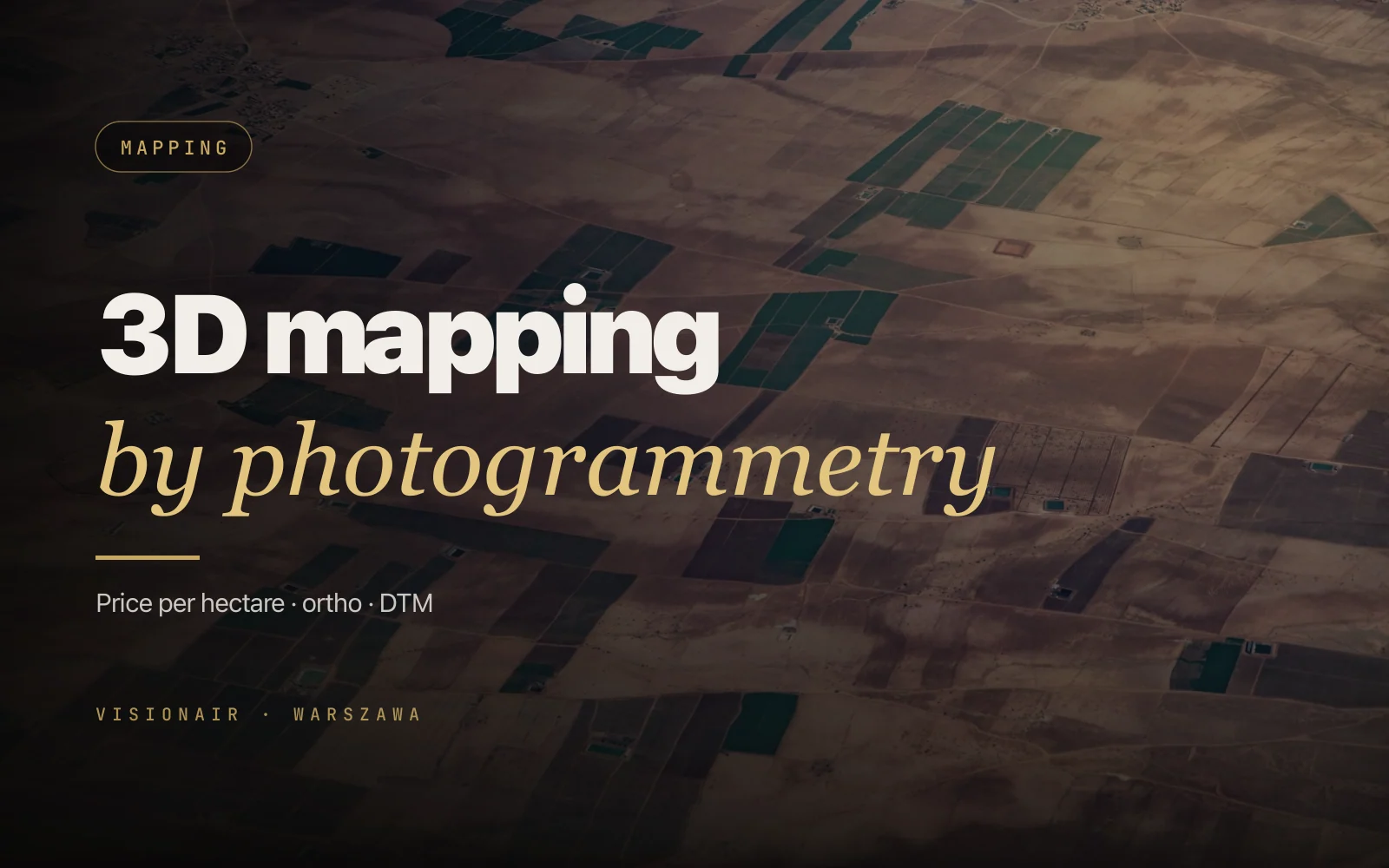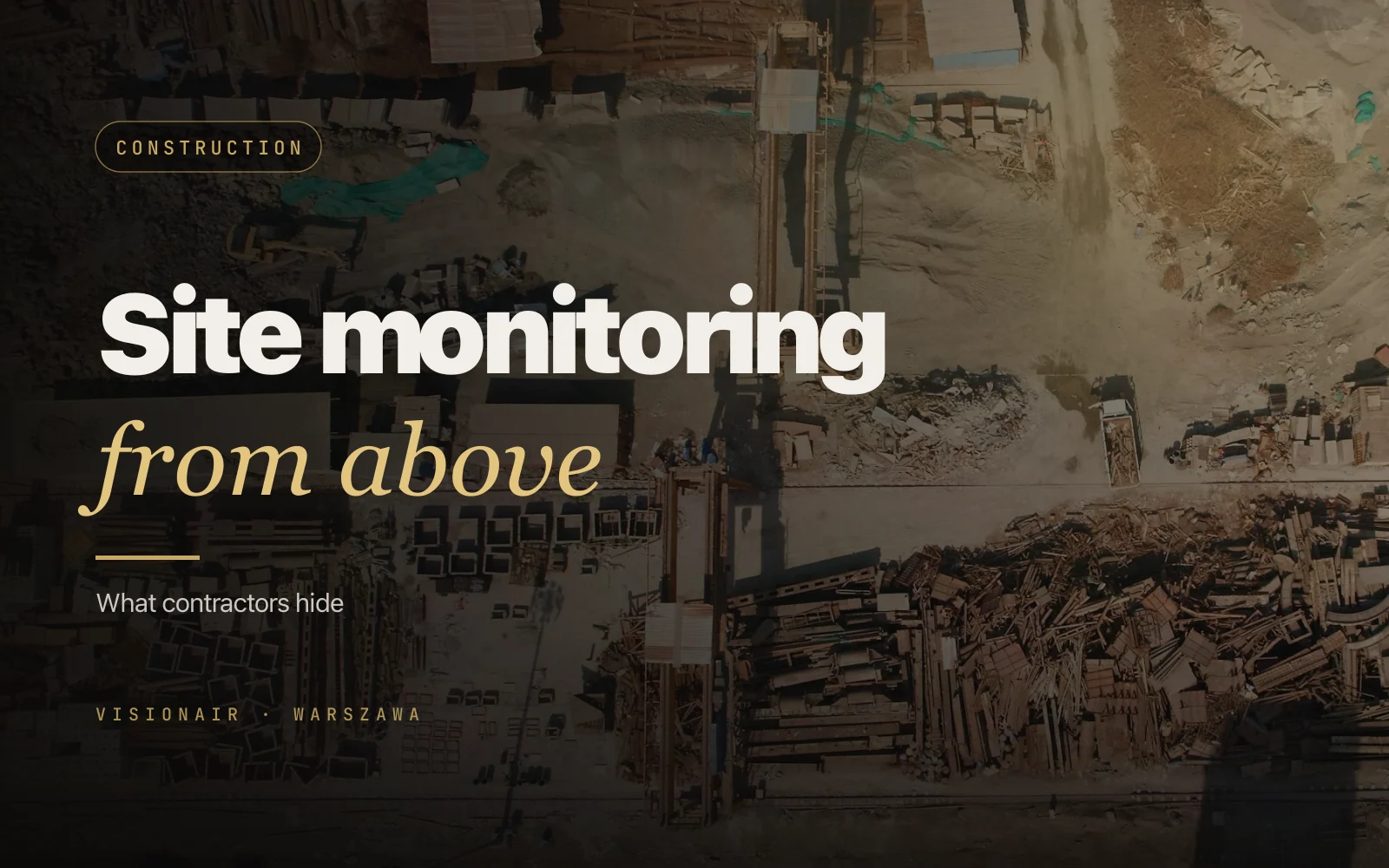
7 types of contractor misrepresentation only a drone can see
- 1. Photos always from the same angle. The contractor keeps showing the same convenient framing, so that messy material yards, an uneven excavation or unfinished drainage stay out of shot. A drone on orbital flight removes the option to cherry-pick the angle.
- 2. Volume of removed soil known only from delivery notes. The true excavation volume is computed from a 3D point cloud before and after. A 5-15 percent gap between delivery notes and actual volume is a standard finding on residential sites.
- 3. Material stockpiles on site. Materials arrive and are signed off, but a week later 200 brick pallets have turned into 80, and 120 have gone to the contractor's neighbouring site. Visible only when comparing volumetric data from two flights.
- 4. Zone 80 percent complete. Visually confirmed from the ground. A drone with a 23x zoom shows that the façade panels are only fixed at 60 percent of anchor points. Once the scaffolding comes down, that is no longer verifiable without dismantling.
- 5. Drainage installed, checked. The lay angles of drainage pipes are only visible in orthophotos before backfilling. The contractor rushes to backfill the trench to hide deviations of 5-10 degrees from the design.
- 6. Standard 12 piles for the foundation. Delivery notes show 12, the drawing shows 12. After installation, the orthophoto shows 9 boreholes in their photographed positions. The remaining 3 exist only on paper.
- 7. The neighbour signed consent for boundary works. The plot boundary is in the cadastre, the building outline appears in the orthophoto referenced to PL-2000 (Polish geodetic coordinate system). The wall was built 40 cm inside the neighbour's plot - a problem 5 years later, when the neighbour files for demolition (rozbiórka).
What your monthly drone report must show: an 8-parameter checklist
- 1. Orthophoto map of the full site in the PL-2000 coordinate system (the GUGiK standard, Polish Head Office of Geodesy and Cartography) with RTK accuracy of 2-3 cm horizontal and 2-5 cm vertical.
- 2. 3D point cloud in .las or .e57 format for subsequent comparison with the project BIM model (typically IFC or Revit).
- 3. Volume cut-fill analysis: cubic metres of excavation and fill against the earthworks plan. Compared against the contractor's delivery notes.
- 4. Progress comparison: the current month's orthophoto overlaid with the previous one, with changed zones highlighted.
- 5. Hot-spot map: zones running more than 15 percent behind schedule, marked in red with a written cause.
- 6. Side-by-side photos of four key corners of the site against the previous control period.
- 7. Boundary check: position of every new structure relative to the cadastral plot boundaries, with deviations stated in centimetres.
- 8. Health and safety scan: fallen or expired protection, open trenches, condition of crane equipment, presence of markings on scaffolding.
3 monitoring formats and 2026 pricing
- Basic: one photo session per month, one shooting day, photos plus video plus a single overview drone shot. 1,500-2,500 PLN per month. Suitable for sites up to 5,000 sq m (single-family houses, small retail).
- Standard: RTK plus orthophoto map plus cut-fill analysis plus comparison with the previous period, every 2 weeks. 3,500-6,000 PLN per month. The base standard for commercial construction of 5,000-20,000 sq m (residential developments up to 50 apartments, warehouses).
- Premium: RTK plus 3D point cloud plus an investor dashboard with weekly updates plus boundary monitoring plus a health and safety scan. 8,000-14,000 PLN per month. For projects above 20,000 sq m or multi-site portfolios (developments above 100 apartments, logistics centres, road infrastructure).
Case: an orthophoto exposed a 184,000 PLN discrepancy in Wilanów
An 84-apartment development in Wilanów (premium residential district of Warsaw), earthworks phase, January-March 2024. The general contractor billed the developer for hauling 8,500 cubic metres of soil to the Łubna landfill at 80 PLN per cubic metre. Documentation - subcontractor delivery notes with logistics and tipper-truck driver signatures.
VisionAir flew two RTK missions: a baseline before earthworks began, and a comparison flight after the phase. The 3D point cloud put the actual excavation volume at 6,200 cubic metres with ±3 percent error. A 2,300 cubic metre gap against the contractor's notes. The financial equivalent - 184,000 PLN invoiced but never physically removed. After the report was presented to the investor, the contractor revised the cost estimate and offset the amount in the next tranche. ROI on drone monitoring that month - 65x.
When a drone does not replace a site engineer
- Concrete quality: requires laboratory testing (15x15 cm cube, tested at 7 and 28 days).
- Electrical and plumbing inside walls: a drone cannot see through plasterboard; an on-site engineer with a thermal camera and tester is needed.
- Waterproofing of panel joints: requires an on-site FLIR scanner and an engineer-operator.
- Weld quality: penetrant inspection and ultrasonic testing are on-site only.
- The drone is an addition, not a replacement. The quality-control standard is 1 monthly visit by the inspecting engineer plus 2 drone visits every 2 weeks (one full RTK every 2 weeks plus one visual progress run every 2 weeks).
Where drones deliver the highest ROI
- Residential developments above 50 apartments: ROI 8-15x over the year (volume misrepresentation plus delays plus boundary issues).
- Logistics centres and warehouses above 10,000 sq m: ROI 5-10x (large footprint, limited ground-level visibility).
- Roads and linear infrastructure: ROI 12-20x (long sites; classic survey work is expensive and slow).
- PV farms and solar parks: ROI 4-8x (grid layout check plus 3D plus later thermal inspection of modules).
- Renovation in Warsaw's Old Town (Stare Miasto): ROI 2-4x. CTR EPWA zone, individual clearances required for every flight, so drone efficiency drops.
In 2024 we ran 47 monthly drone audits on developer sites in Mazowieckie. In 23 of 47 (49 percent) we identified factual discrepancies with the contractor's monthly invoicing of between 80,000 and 380,000 PLN. In 11 of those 23 cases, the drone report material became the basis for holding back a tranche until the cost estimate was revised. The drone pays for itself within a single control cycle.
Frequently asked questions
- How much does monthly monitoring cost for a 12,000 sq m development?
- The standard package for a 12,000 sq m site is 4,500-5,500 PLN per month. It includes an RTK flight every 2 weeks, a PL-2000 orthophoto, cut-fill analysis, side-by-side comparison with the previous period, and a 15-20 page PDF report. Contracts are usually 8-14 months long (earthworks plus structure plus façades). The baseline flight before work starts is a separate 2,800 PLN; it also serves as the control point for every subsequent report.
- Will PKO BP and mBank accept your orthophotos for tranche release?
- Yes. The banks' condition is that RTK accuracy is confirmed by GUGiK control points on the plot (a minimum of 4 points per 5,000 sq m), the report is signed by an operator with current ULC registration, and the orthophoto is provided as PL-2000 GeoTIFF. PKO BP accepts it directly; mBank goes through its technical advisor. Pekao also requires confirmation from a licensed surveyor (a geodesist with GUGiK qualifications), which adds 800-1,200 PLN per report.
- Can we receive a real-time dashboard, or only a monthly PDF?
- The premium package includes a web dashboard on PIX4Dcloud or DroneDeploy, with access for the investor, the general contractor and the technical advisor. Updates happen after each drone visit (weekly or biweekly), not in real time, because photogrammetric processing takes 12-24 hours. Real-time live streaming from the drone is possible for critical operations (foundation pour, roof installation) as an add-on at 1,500 PLN per day.