What a drone films at a wedding - the day in six shots
Six shot types realistically fit into one wedding day: the couple's arrival, the location session, the hall reveal, the first dance from above, the group shot of all guests, and establishing shots of the venue itself. It is not a fixed kit - it depends on weather, the hall, and the time of day - but every conversation about the film starts here.
It helps to split the day in two. Ceremony shots cover the arrival, the ceremony and the location session after leaving the USC (Polish civil registry office) or the church. Reception shots are the hall: the couple's entrance, the dance, the party, the evening fireworks. The drone works in both, but indoors it has a tight margin, and we will explain why.
Below we show each shot on its own: what we call it on the job, which moment of the day it maps to, and how the finished clip looks on screen - how long it runs, the pace, whether it goes in slow motion.
The couple's arrival - the first dynamic shot
The most common opening shot is a follow shot. The drone trails the car, the carriage, or the couple walking the path to the manor. The camera stays behind their backs while the background gradually opens up as the drone gains a little altitude. On screen it is 5-8 seconds of smooth motion, usually with a touch of slow motion at the end as the couple enters the frame.
The walking variant works beautifully at the entrance to a registry office or palace. The couple walks while the drone pulls back and rises at the same time - a reveal shot, where the surroundings flow in from below and the sides. It works well as an introduction to the location in the first seconds, before the viewer even sees a face.
Location session - orbit, top-down, landscape reveal
On location the drone shows its full range, because there is no crowd and there is space. The flagship shot is the orbit: the drone circles the couple standing on a meadow, a pier, or a courtyard at a slow, cinematic pace. The couple stays centred while the world rotates around them. On screen it is 6-10 seconds, almost always in slow motion and set to music.
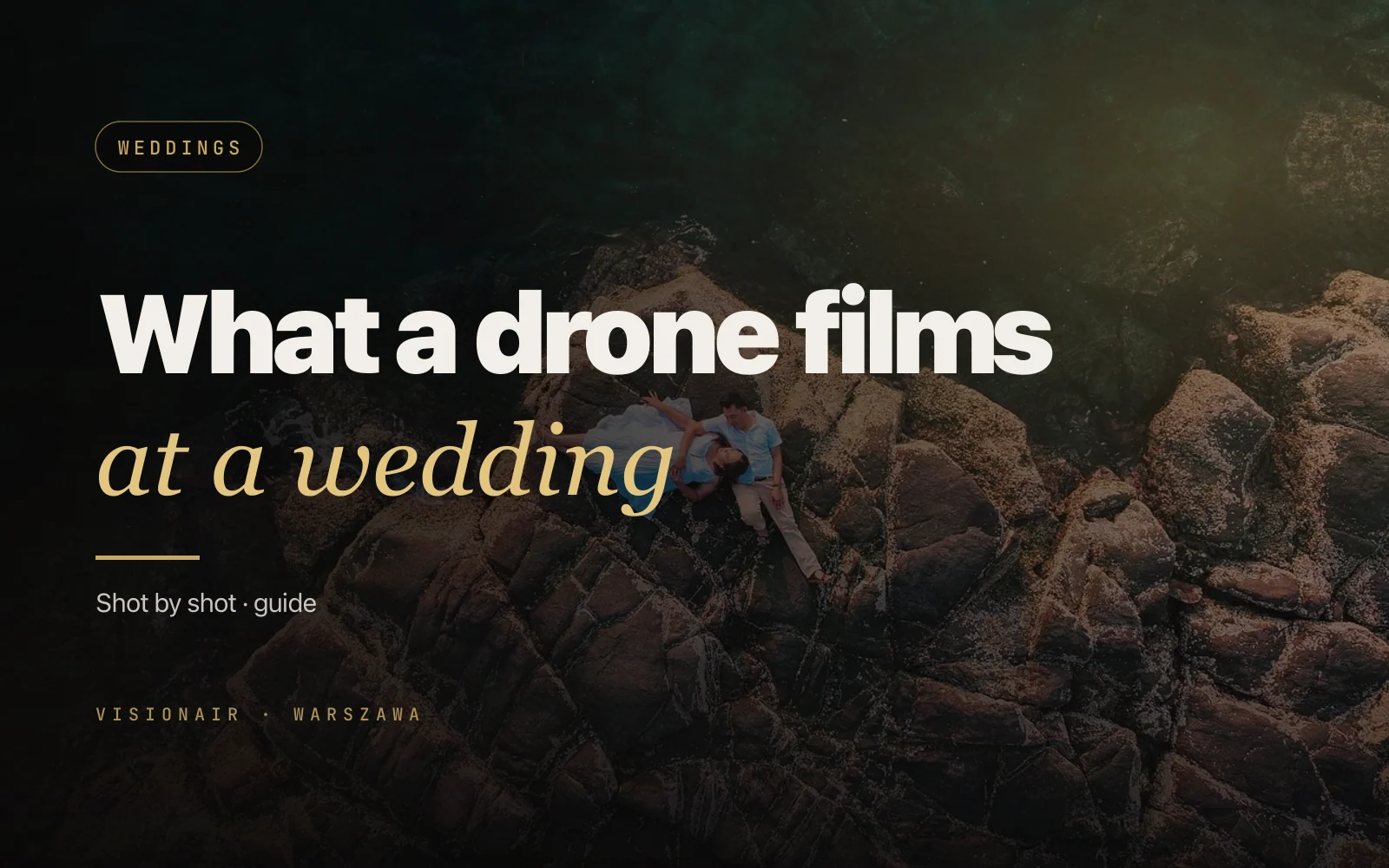
Top-down is a shot straight from overhead. The couple becomes a point in the composition - on a jetty over a lake, in the middle of a field, on courtyard cobblestones. It looks graphic and cuts cleanly into the edit as a break. A landscape reveal starts close on the couple, then the drone rises and uncovers the panorama: forest, palace, the sheet of water. This is the shot guests talk about most afterwards.
- Orbit - the drone circles the couple in slow motion, the most recognisable wedding shot
- Top-down - the camera straight overhead, the couple as a composition element in the landscape
- Reveal - start on the couple, rise and uncover the lake, forest, or palace panorama
- Pace: slow, cinematic 4K, usually under a music bed with no on-site audio
If you are still choosing a location, the spot does half the work - a pier over a lake or a palace courtyard gives a completely different shot than the lawn behind the hall. We have a separate piece on the best aerial-wedding locations around Warsaw, so we will not repeat it here.
Hall reveal and the entrance - the wow effect on FPV
A drone hall reveal is the strongest opening for the evening reportage. A classic drone cannot do it - that is where FPV comes in. A small craft like the Avata flies in through an open door or window, passes over the dance floor, and comes out on the couple by the entrance. All in one unbroken shot - a fly-through.
The difference is simple. A classic Mavic flies steady and from a distance, great outdoors. FPV is agile, slips into tight spaces, and gives a dynamism the Mavic cannot match - which is why it is the one taken indoors. We have a separate article on how FPV differs from a regular drone if you want to go deeper.
On screen it is a single smooth 8-15 second shot, plenty of movement, the camera dipping and rising between tables. It works as a powerful intro to the whole wedding film. But not every hall fits: you need a high ceiling, no low-hanging chandeliers, and a moment when guests are not yet packed around the dance floor.
First dance from above - what works and what does not
A first dance from above looks stunning: a top-down over the couple spinning on the floor, the lights spreading in rays. There is one hard condition, though. In the open category, which is where a commercial wedding operator flies, there is an absolute ban on flying over a gathering of people. A crowd of guests is exactly such a gathering.
In practice this means: over a full hall of guests the drone will not fly. A first dance from above can be filmed, but only when the dance floor is empty and the guests are pushed back to the sides past a safe boundary. It often works better outdoors in the evening - a dance on a pier or in a courtyard, where there is no crowd beneath the craft.
- Empty dance floor, guests moved to the sides - then a top-down over the couple is possible
- Higher altitude and a side angle instead of straight overhead when space is tight
- Moving guests for the shot, agreed in advance with the couple and the MC
- An evening location, fireworks, or illumination - the alternative when the hall does not allow it
A good operator does not promise a pass over a lively dance floor, because it is simply illegal and unsafe. Instead they offer a solution: either a planned moment with an empty floor, or an outdoor dance after sunset. The result is sometimes better than fighting for a shot over a crowd.
Group shot of all guests - a keepsake classic
A drone group shot of all the guests is one of the most requested frames. Everyone lines up into a word, a heart, or a circle, the drone rises vertically, and shoots both a photo and a short video from above at once. In the photo you count heads later, in the video you see everyone waving at the camera - that hits hard when you watch the film months on.
Logistically it is 3-5 minutes, but someone has to arrange the people - usually the MC or the best man. Best done before the dinner, while guests are all present, sober, and have not scattered. Important: this is a shot with guests pushed back under the operator's control, not a flight over a running crowd, so we plan it deliberately.
Establishing and transitions - the shots that hold the film together
These are the shots the couple usually does not notice, and without which the film looks flat. Establishing means frames of the venue with no people: the manor, the church, the driveway, the surroundings in the golden hour just before sunset. In the edit they serve as the intro, transitions between scenes, and a backdrop for titles with the date or names.
Night shots belong here too - the lit hall, the city in the background, the courtyard illumination. Filming after dark is a separate technical topic, since the drone needs steady light and different settings; we wrote about it in our piece on night drone filming. Without these frames the reportage jumps from scene to scene too hard, as if there were no breath between shots.
The couple orders the orbit and the group shot, and then on the finished film what hits them hardest is those three seconds of the manor at sunset that nobody ordered. Establishing is the glue that holds the whole thing together.
Will the drone fly over us and the guests - law and safety 2026
The most honest answer to whether a drone can fly over guests at a wedding: not over a crowd. The EASA open category carries an absolute ban on flights over gatherings of people, and a crowd of wedding guests is exactly that. This is not about how brave the operator is - it is hard law.
What that means in practice is shown by the subcategory table. The operator picks altitude, distance, and angle so that people are not directly beneath the craft - hence shots from the side, from a greater height, or with guests moved back.
| Subcategory | What is allowed | What it means at a wedding |
|---|---|---|
| A1 | Flight over bystanders, but NOT over gatherings | Single people yes, a crowd of guests no |
| A2 | Min. 30 m from people (or 5 m in slow mode ≤3 m/s) | Shots at a distance from the group of guests |
| A3 | Min. 150 m from built-up and residential areas | Location work away from buildings |
Warsaw is also the controlled CTR zone of Chopin Airport (EPWA - the ICAO code for Okęcie). A flight here requires clearance and coordination through an app like DroneTower or PansaUTM. We covered separately how clearances work in the Warsaw CTR zone, so here we just flag it: without coordination you cannot legally take off.
- Operator registration in the drony.gov.pl system - mandatory for drones over 250 g or with a camera regardless of weight; the operator gets a POL-XXXXXXXXX ID stuck on the craft
- Operator OC (third-party liability) insurance mandatory from 13 November 2025 for drones 250 g - 20 kg, minimum sum 50 000 SDR (about 270 000 PLN), fine for not having it up to 4000 PLN
- Competence: the A1/A3 exam is a free online test (40 questions, 75% pass, valid indefinitely); A2 is a paid course with practical training, valid 5 years
- Flight ceiling in the open category: up to 120 m above ground, always within visual line of sight (VLOS)
A separate matter is guests' image rights and RODO (Poland's implementation of GDPR): who is filmed and how, and where the footage goes. That is a topic for a separate article, which we have, so here we just note that a good operator explains to the couple what consent to filming guests looks like.
What to realistically expect - weather, noise, time
Weather can ground the drone. Strong wind, rain, or fog is a hard no for flying, and no operator can work around it. That is why we always agree a plan B - shifting the drone shots to another moment of the day or to a weather window we catch between scenes.
A drone is audible. For that reason we do not fly during the vows or the ceremony itself - that is a moment the sound of the motors has no right to spoil. We shoot the arrival, the exit from the church or registry office, the location session, and the hall, and we leave the vows to the ground cameras. Well-planned flights are built around the emotions, not on top of them.
Realistically a few blocks fit into one day: arrival, location, group shot, and reveal or evening. We are limited by the battery, by moving guests around, and by clearances in the zone. In the final film the drone is usually anywhere from a dozen seconds to 1-2 minutes - the rest of the day lives on the ground cameras. That is not a flaw, it is how editing works: aerial shots are meant to be an accent, not the whole film.
Frequently asked questions
- Can a drone fly over guests at a wedding?
- Not over a crowd. The open category carries an absolute ban on flights over a gathering of people, so over a full hall of guests the drone will not fly. The operator works from the side, higher up, or when guests are moved back. Over single people it is allowed in A1, in A2 with a 30 m distance. That is why a first dance from above is only done with an empty dance floor.
- Which drone shot at a wedding looks best?
- Two are the strongest: an orbit around the couple on location in slow motion, and a reveal that uncovers the landscape behind them. Indoors, a fly-through on an FPV drone through the door over the dance floor is striking. A top-down group shot stays as a keepsake. These work because they give scale and motion that a handheld camera cannot catch.
- Can a drone film the first dance in the hall?
- Yes, but conditionally. You need a high ceiling, safe space with no chandeliers over the dance floor, and either an empty floor or guests moved to the sides. If the hall is low or packed, an evening outdoor dance or an FPV fly-through at the entrance works better. We say plainly when a hall does not fit.
- How many drone shots fit into one wedding day?
- Realistically a few blocks: arrival, location, group shot, and reveal or evening. The battery, the weather, and moving guests around limit it. In the finished film the drone is usually a dozen seconds to 1-2 minutes of footage. The rest of the day rests on the ground cameras, and the aerial shots act as an accent.
- Do you need clearance to fly a drone at a wedding in Warsaw?
- Yes. Warsaw lies in the CTR zone of Chopin Airport (EPWA), so a flight requires clearance and coordination through an app like DroneTower or PansaUTM. The operator must have registration on drony.gov.pl, OC insurance (mandatory from 13 November 2025), and the right A1/A2/A3 competence.
- Does the drone disturb the ceremony?
- A drone is audible, so we do not fly during the vows or the ceremony itself. We shoot the arrival, the exit, the location session, and the hall, and we leave the most important moment to the ground cameras. Flights are planned around the flow of the day so that the sound of the motors never enters the emotion.