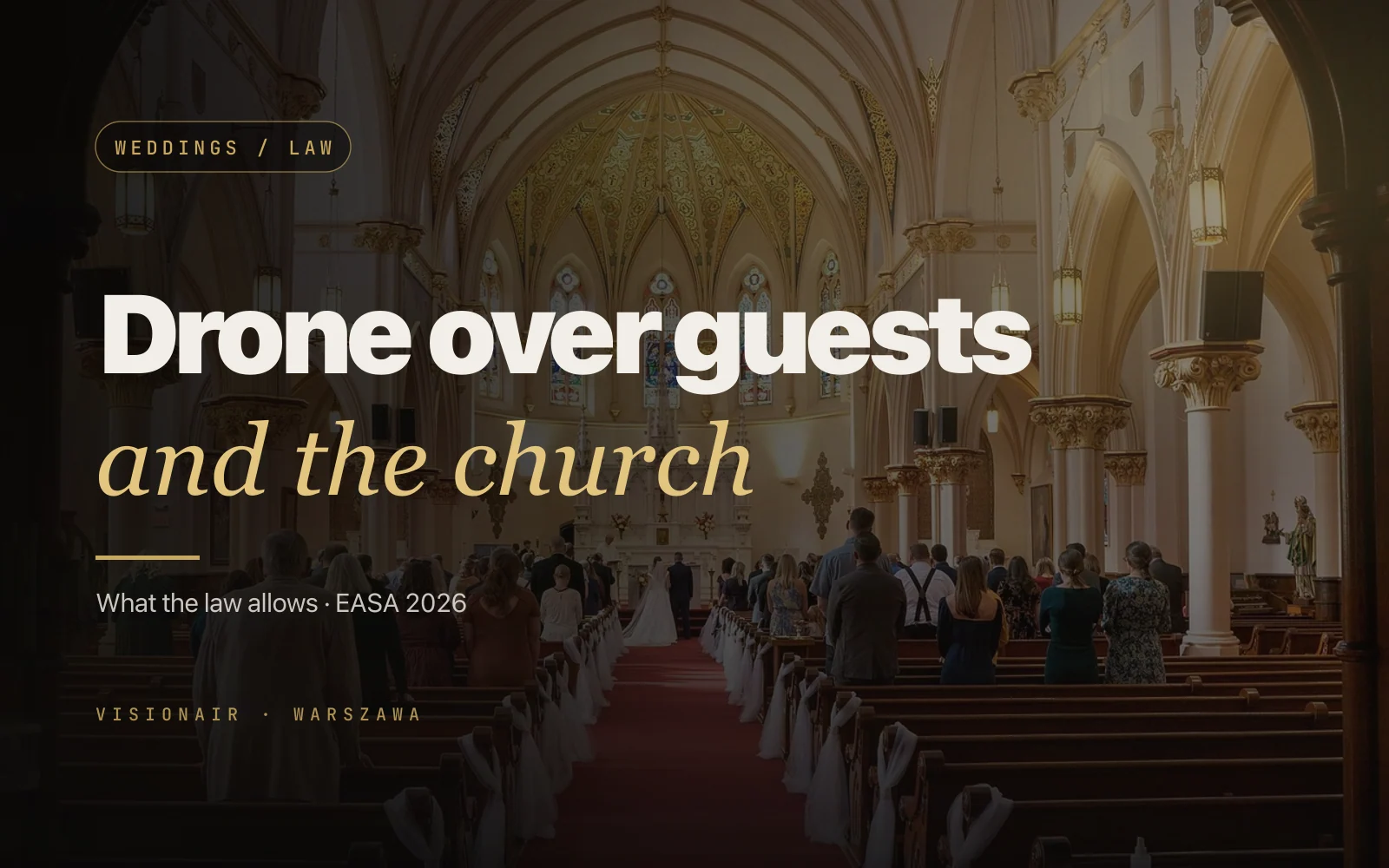
The short answer: can a drone fly over guests and over the church
Over single, scattered people in subcategory A1 - yes, a light drone may. Over an assembly of people - never, in no open-category subcategory and in no zone. A wedding and the crowd of guests outside the church almost always meet the definition of an assembly, so flying directly over their heads is simply banned. That's why the striking shots come from the side, from a distance, and over empty space, not over the couple and the guests.
If an operator promises you a shot 'right over the first dance' or 'a flyover above all the guests outside the church', that's a sign they either don't know the rules or are breaking them on purpose. The cost of the service is a separate topic, which we unpack in our article on wedding drone filming prices in Warsaw.
What the law treats as an 'assembly of people' and when your wedding is one
ULC (the Polish Civil Aviation Authority) and EASA define an assembly of people as a cluster so dense that an individual cannot freely move away or escape from under the drone if it fails. It isn't about the number of guests, but about density and freedom of movement. A hundred people spread across a large garden is not the same as forty people packed onto the church steps.
ULC and EASA materials list the qualifying examples explicitly: religious services, fairs, parades, concerts. A church ceremony and a crowd of guests waiting for the couple to exit fit that description precisely. By contrast, scattered couples strolling around an outdoor venue, where anyone can calmly step aside, is not yet an assembly. The operator has to be able to judge that difference on site, not after the fact.
Safe distances and the A1, A2, A3 categories at a real wedding
The open category means line-of-sight flights (VLOS), a drone under 25 kg, and a ceiling of 120 m above the nearest point of terrain. Within it there are three subcategories, and each treats people differently.
- A1 - flying over single people is allowed, but not over an assembly. The drone class matters too: a lighter C0 has more freedom than a C1.
- A2 - a minimum of 30 m horizontally from people, dropping to 5 m in low-speed mode. A2 needs a separate exam.
- A3 - a minimum of 150 m from residential, recreational, commercial and industrial areas. This is the 'far from people' subcategory.
- Over an assembly there is no safe vertical distance at all - you simply don't do it in the open category.
In practice the operator picks the altitude, distance and flight path to skirt the crowd: an entry over an empty driveway, an arc along the side of the garden, a push-in on the couple from a safe distance. Never a shot straight over the heads of the gathered guests. With a good lens and an altitude of 40-60 m, the 'over the wedding' look is achievable without breaking the rules.
The church and the ceremony: the priest's consent, parish rules, noise
The church and its grounds are parish property, managed by the parish priest (proboszcz) or an administrator. Aviation rules are one thing, but regardless of them you need the parish's consent for the drone's presence and flights near the building. Many parishes have their own rules and some don't allow any equipment during the liturgy at all.
Then there's noise. A drone produces roughly 60-80 dB, and that carries in the silence of a ceremony. So you don't fly during the Mass or the vows. The shots are taken before the couple enters, after they leave the church, and from outside the building. Our rule is simple: we agree the terms with the parish in advance, plan the entry and exit shots, and warn the guests when the drone takes off.
The worst moment for a drone is the vows inside the church. We sort it out with the parish a week ahead, and we almost always still get a beautiful entry of the couple, the exit, and a shot from outside. Nobody flies over the altar during Mass.
When it becomes the specific category and SORA, and when it doesn't
A flight directly over an assembly leaves the open category and enters the specific category. That requires a ULC authorisation and a SORA risk assessment (the JARUS methodology adapted by EASA). It's a weeks-long procedure costing thousands of zloty, completely uneconomical for a single wedding.
So for a typical wedding no sensible operator runs a SORA. The flight is simply planned to stay in the open category: distance, going around the crowd, no passes over heads. The red flag is an operator promising a flyover 'right over the couple and the guests' without authorisation - they're breaking the law, and in an incident liability falls on you as the client too.
Mandatory drone operator insurance from 13 November 2025
From 13 November 2025, OC (third-party liability insurance) is mandatory for every drone weighing 250 g to 20 kg - this covers recreational, sports and commercial flights. A paid wedding is a commercial flight, so the operator must hold a commercial policy, not a hobby one. The minimum sum insured is 50,000 SDR, roughly 1.2 million PLN (the exact figure depends on the current SDR rate). No valid OC means an administrative fine of up to 4,000 PLN.
| Item | Value / range PLN 2026 | Note |
|---|---|---|
| Mandatory OC - recreational tier | approx. 150-300 PLN / year | Not enough for a paid wedding |
| Operator OC - commercial tier | approx. 400-900 PLN / year | This is what to demand for a wedding |
| Minimum sum insured | 50,000 SDR (~1.2 million PLN) | Premium varies by insurer (PZU, Wiener, Warta) |
| Fine for no valid OC | up to 4,000 PLN | After 13.11.2025, administrative |
| Specific-category authorisation + SORA | a few thousand PLN, weeks of process | Usually skipped for a wedding |
The exact OC premiums differ between insurers (PZU, Wiener, Warta) and depend on the chosen sum insured. Before you sign, ask the operator for the commercial policy number and the certificate of competency. Two things the 'cousin with a DJI off the classifieds' usually doesn't have.
RODO and guest privacy: recording people from the air
Guests' likeness recorded by a drone is personal data under RODO (the Polish implementation of GDPR). The controller is usually the couple or the client, while the operator acts as the processor. You need a processing basis and you must inform the guests that the ceremony and reception are being filmed, including by drone. Watch out for capturing neighbours' property too, if the venue borders someone else's land - we go deeper into this in our piece on RODO and drone photography.
- A note on the invitation or the day's agenda: 'photo and video recording, including by drone, is being conducted'.
- No shots of third parties outside the wedding - random passers-by or neighbours.
- Raw footage stored on EU servers with a clear deletion deadline.
- The option to request a specific guest be cut from the final edit.
Warsaw and around: zones, CTR EPWA and flight notifications
A wedding in central Warsaw, or close to Okęcie (EPWA, Chopin Airport) or Modlin, almost certainly sits inside the CTR controlled airspace. That means a mandatory check of the geographical zones in the app and a notification or coordination of the flight before the drone even takes off. Some venues outside Warsaw are beyond the CTR, but the zones still need verifying.
Here a local Warsaw operator wins, the one who handles the paperwork ahead of time: checks the zone for the specific address, does the check-in, and doesn't leave it to the last minute. We describe the procedures in a separate text on permits for drone flights in Warsaw and the CTR EPWA zone.
A couple's checklist: how to hire an operator who won't break the law
- Pilot's certificate of competency: at minimum the A1/A3 online training, and the A2 exam for flights closer to people. Operator and pilot registered on drony.gov.pl.
- A valid commercial OC policy and a drone with a C-class marking.
- A flight plan in writing: where and when the drone flies, how it avoids guests and the ceremony, when it doesn't take off at all.
- Consent from the parish and from the venue owner, preferably in writing.
- A clear statement: no passes over an assembly or over guests' heads.
If you want to see straight away what a full set of operator credentials looks like and which venues around Warsaw give the best shots, take a look at our article on the A1/A2/A3 drone operator certificate and top aerial wedding locations.
Frequently asked questions
- Can a drone fly over guests at a wedding?
- Not over an assembly - that's banned in the open category always and everywhere, in any subcategory and zone. Over single, scattered people in A1, yes. The operator plans shots from the side and from a distance, never directly over the crowd of guests.
- Is the priest's consent needed for a drone at the church?
- Yes. The church and its grounds are parish property, so regardless of aviation rules you must get the consent of the priest or administrator. Many parishes don't allow flights during the liturgy, so the shots are taken before and after the ceremony.
- What distance from people must a drone keep?
- It depends on the subcategory. In A2 it's a minimum of 30 m horizontally, dropping to 5 m in low-speed mode. In A3 it's a minimum of 150 m from built-up areas. Over an assembly there is no permitted distance - it's simply not allowed.
- Must a wedding drone operator have insurance?
- Yes. From 13 November 2025, OC is mandatory for drones from 250 g to 20 kg, and a wedding is a commercial flight, so the commercial tier is needed. The minimum sum insured is 50,000 SDR (about 1.2 million PLN), and lacking a policy risks a fine of up to 4,000 PLN.
- Does a drone disturb the ceremony inside the church?
- Yes. A drone produces around 60-80 dB and isn't flown during the liturgy or the vows. The shots are taken before and after the ceremony and from outside the building, after agreeing the terms with the parish in advance.
- Does filming a wedding by drone over people need ULC authorisation?
- If you plan a flight directly over an assembly, you leave the open category and enter the specific one, which requires a ULC authorisation and a SORA assessment. That's why for a wedding the flight is planned to stay in the open category in the first place.